This is the home of Schulenberg's AS10 class. It is at this site where you may find homework assignments from class, inquiry requests, and supporting documents for class material.

Wednesday, February 28, 2018

February 28th

Happy LAST day of February!!  Only 2 1/2 more weeks left until SPRING BREAK!!

Today we are working on the close readings/annotations that we started on Tuesday.  These close readings are due at the end of the hour. Before you turn in your annotated passages, you will need to submit a literary claim about Oedipus Rex that is developed from your annotations.  We practiced these on Monday with irony and motif.

Your claim must:
1. Address what you notice (What)
2. Address a literary device (How)
3. Address the implications of the use of this device in the literary text. (Why)

Example:
The characterization of Oedipus is set up in direct opposition to that of Creon in order to emphasize the weaknesses of Oedipus as a king and leader of Thebes.

Please submit your claim by the end of the hour.

FOR THURSDAY:
We will have a quiz over the entire play with a few literary devices questions. (Irony, motif, tragedy)

Image result for oedipus rex meme

Class schedule today-
1st- 8:30-9:12
2nd- 9:17-9:59
3rd- 10:04-10:46
4th- 10:51-11:33
5th- 11:38-12:50
6th- 12:55-1:37
7th- 1:42-2:23
Lunch-
1st- 11:38-12:02
2nd- 12:02-12:26
3rd- 12:26-12:50

Tuesday, February 27, 2018

February 27th

1. Annotating a literary text:
Interactive Reading... Close Reading... Annotation

2. Oedipus Rex close reading exercise.
Oedipus Rex- Close Reading Passages

You have been given 11 passages that are from the beginning to mid-play. These are significant passages that are important to many aspects of the play. We are going to work on annotation today. You have been given these passages in small-doses so you can work on doing an in-depth reading of the play.

Things to look for:
  • Who is speaking? To whom are they speaking?
  • What is the context of this passage? 
  • Any important words? Patterns?
  • Literary devices?
  • What is the significance of this passage to the entire play? 
  • Are there any similarities in the passages... multiple passages? Motif... theme.. 
  • What questions are raised? 
2. For Wednesday, have all 11 passages annotated with coinciding notes done by the end of the class hour.

Monday, February 26, 2018

February 26th

You have examined the literary devices of IRONY and MOTIF.
We will briefly review these concepts at the beginning of class today.

You have had an electronic conversation about these devices together. Today in class we are going to have a small group discussion about the impact of irony on the play.

As a group:
1. Review the three types of irony.
2. As a group, come up with modern examples of each of the types of irony.
3. Review your examples of irony seen in Oedipus Rex. Discuss the significance of the these examples to the overall text? Why is information revealed in this manner? What is the advantage? What effect does it have on the audience?

4. Discuss motif... the general definition.
5. What would be the motif of your group be?
6. Discuss your examples of blindness as a motif in OR. 
7. Review the definition of THEME and how a theme develops..
8.  Can the motif of blindness lead to what kind of theme?

BY THE END OF THE HOUR:
Go to Google Classroom- post a literary claim addressing the use of irony in OR.. AND the use of motif in OR. 

Claim Reminders: 
1. It must be analyzing a specific device of a text (the 'how').
2. It is theorizing the 'why'.  What is the significance of this to the meaning/workings of the text. What are the implications of its usage? How does it impact other aspects of the text/other devices?
3. It is not a statement of fact... Sophocles uses irony... statement of fact.

For TUESDAY:
1. Finish the play.
2. Find/purchase/borrow post-it notes. Bring to class.

Monday, February 19, 2018

Friday, February 23rd.

You should be up to page 314. in Oedipus Rex for today.

Today we are going to have an online discussion about IRONY and MOTIFS.  You will need to post and respond to both posts.

TERMS TO KNOW:

Dramatic Irony: The audience knows something that the characters do not.
Dramatic Irony Examples

Situational Irony: When actions or events have the opposite result from what is expected or intended.
Examples of Situational Irony

Verbal Irony: When a speaker states something in contrast to what they actually mean. (Can be sarcasm.. or understatement)
Examples of Verbal Irony

Motif: a motif is a recurrent image, sound, action that have symbolic significance that help develop the theme of the work.

In Google Classroom, you will see the following post:

Post two examples of Dramatic/Thematic/Situational Irony in Oedipus Rex. Post your quote with the line numbers.  Identify your example as dramatic/thematic/situational irony. 

As you start reviewing the examples of lines of irony in Oedipus Rex, respond to a minimum of two lines discussing the significance of the examples to the overall text. The lines are the "what" and the naming of the device is the "how"... you are now going to provide the "why"? What is the significance to the meaning of the text? 

In Google Classroom, you will see the following post:

Post an example of the MOTIF of BLINDNESS in Oedipus Rex.  Please post the quote with the accompanying line numbers. 

As you start reviewing the examples of the motif of blindness in Oedipus Rex, respond with your explanation of the significance of this example to the meaning of the text to ONE classmate's response. You can address the context of this reference; what kind of effect is the motif having collectively in the play; what do we understand better through this reference... etc. 

Have your responses completed by MONDAY at the beginning of class. 

FOR TUESDAY: Finish the PLAY. 

Friday, February 16, 2018

February 16th

1. You will take Stasimon #1 from Oedipus Rex. Do a quick read through. On Google Classroom, open a Google Document and you will need to write down all of your annotations from your reading of the Stasimon. You will want to consider:
  • Context of the stasimon
  • Purpose of a Chorus-5
  • How the stasimon is fulfilling the purpose. 
  • Structure of the stasimon
  • The How and the Why of this specific chorus. 
Due by the end of the class period.

FOR TUESDAY:
Read pages 287-300 for class on Tuesday.
Take very thorough notes.

I showed the following video to my Thursday classes.. If you missed it, please give it a watch. Think about the information that you are privy to through social media and daily in the halls that the adults around you do not have access to.

Sandy Hook Video

Here is the link to the SafeSchools anonymous tip line:
LSN SafeSchools Alert

Wednesday, February 14, 2018

February 14th

Happy Valentine's Day! 

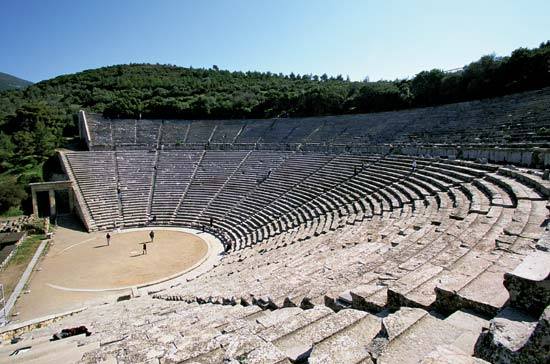
Introduction to Greek Theater:

Greek Theater
Sophocles and Oedipus 

Small group discussion-  Oedipus Rex Parados Annotation/Analysis Exercise
As you discuss the following questions, take effective notes on the concepts discussed. 
Remember the 4 expectations of group work: 1. Everyone participates productively 2. Address the assignment, only  3. Each individual is responsible for the material covered during group discussion. 4. Think of Mrs. Cole's  rationale for doing this assignment... and also doing it in this format. 

Parode/Parados (Entrance Ode): The entry chant of the chorus, often in an anapestic (short-short-long) marching rhythm (four feet per line). Generally, they remain on stage throughout the remainder of the play. Although they wear masks, their dancing is expressive, as conveyed by the hands, arms and body. Typically the parode and other choral odes involve the following parts, repeated in order several times:
  1. StrophĂȘ (Turn): A stanza in which the chorus moves in one direction (toward the altar). Expresses a complete thought. Travels East to West. 
  2. AntistrophĂȘ (Counter-Turn): The following stanza, in which it moves in the opposite direction. The antistrophe is in the same meter as the strophe. Another complete thought. Chorus travels West to East. 
  3. Epode (After-Song): The epode is in a different, but related, meter to the strophe and antistrophe, and is chanted by the chorus standing still. The epode is often omitted, so there may be a series of strophe-antistrophe pairs without intervening epodes.
Parados
Summarize Strophe 1,2,3 and Antistrophe 1,2,3.
Strophes and Antistrophes are used to pose questions, problems, solutions and consequences that must be considered by the people/characters/audience.

1.  What problems are presented?
2.  How do the strophes and antistrophes affect the setting or atmosphere?
3.  Who are the people calling on to solve their problems?
4.  Why is it important that Oedipus walks in during Antistrophe 3?
5. What literary devices are being employed in the Parados? How are they being used?


Use the following questions to help guide your examination and analysis of the Parados... you will soon need to be able to do this independently. 
  1. What roles do the Gods play in the Parados/Stasimon? 
  2. In what ways is it responding to what has just happened in the previous episode? 
  3. How are the needs of the chorus members/citizens different from the characters in the episode
  4. What figurative language is being used and how? Metaphor? Similes? Personification?
  5. What is the Parados/Stasimon's major theme and/or argument? 
  6. What other literary elements do you see and how are they being used? 
  7.  Structure: Can you determine the strophe? antistrophe? epode? Remember the concept of the sonnet? The quatrains/sestets/couplets? They derive from the Greek Chorus. Not only does the structure get fragmented, you will see the meaning shift. 

Now that we know that Oedipus killed Laius before the play begins, I want you to look back at the prologue and, in your notes, put examples of IRONY... Verbal, Situational, and Dramatic.

FOR FRIDAY:
Make sure that you are read up to lines 575 for Friday. 

Monday, February 12, 2018

February 12th

Field Trip Announcements:
1. Be to the west doors (by Guidance) by 8:40 AM. The bus leaves at 8:45.
2. Bring money for lunch.
3. Alert your teachers to your absence on Tuesday.
4. Dress for the theater.

Today in class: 
1. We have read the opening episode of Oedipus Rex. Once again, we begin with the plague and questions of why it is killing the people. Oedipus must figure out the cause of the plague to save the people of Thebes.

Some questions to consider: 
1. What is significant about the first line being a question?
2. What are your initial impressions of King Oedipus?
3. How does the priest describe the people of Thebes' view of their king?
4. What do we learn about Oedipus' past from the priest?
5. What action does Oedipus take to solve the problems affecting Thebes?
6. When Creon arrives from the Oracle, what does Oedipus insist that he does? What does this tell us about his character?
7. What does Creon report from the Oracle?
8. What is Oedipus' response to this news?
9. What is the dramatic irony that surrounds Oedipus' response?

Dramatic Irony: a literary technique, originally used in Greek tragedy, by which the full significance of a character's words or actions are clear to the audience or reader although unknown to the character.

10. What does Oedipus promise to do for Thebes?

For Wednesday/Thursday:

1. Read and TAKE NOTES on the following handout on the purpose of the Chorus. Role of the Chorus- Greek Theater

2. Read VERY CAREFULLY the first Chorus- Lines 169-244. Read it again. In your second read, look for the five purposes that a Chorus serves... what do we learn in this opening chorus, which is called the PARADOS.  Be ready to discuss your findings on Wednesday/Thursday.

3. Have read up to line 570 for Wednesday/Thursday.

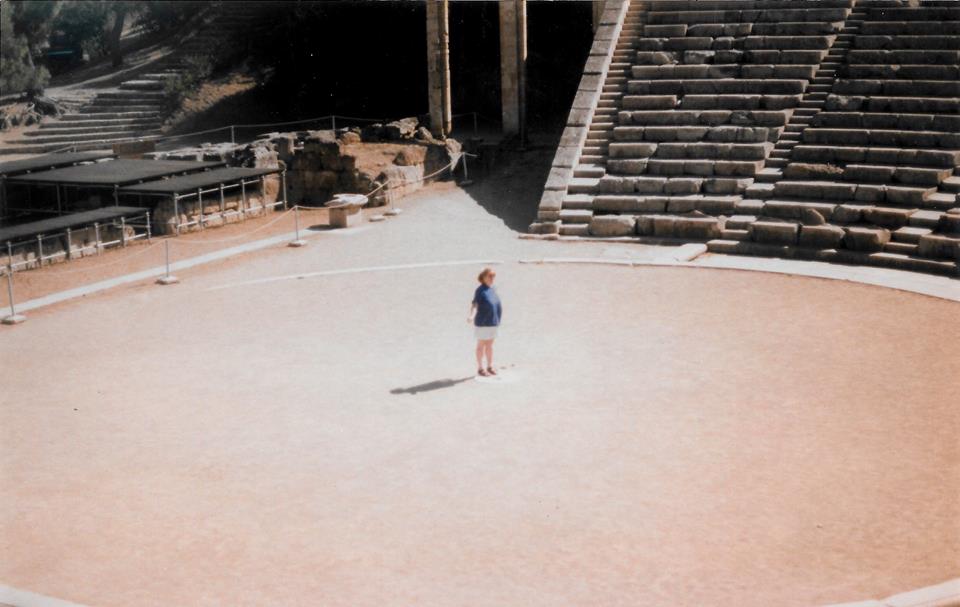
  Epidauras,Greece Mrs. Cole at 22.